

Written by Tim Ward, Mortgage Broker
A guide for homeowners exploring mortgage flexibility
Increasing your amortization may not seem like the obvious choice. After all, you’re voluntarily extending the time it takes to pay off your mortgage. However, this strategy can be a powerful tool for creating financial flexibility when life demands it.
The key insight: the only difference between two mortgages with different amortization periods is the amount of principal you repay each month. The strategy below shows you how to use a longer amortization while still paying down your mortgage just as fast, but with the option to slow down if you ever need to.
How It Works: 20 vs. 25 Year Amortization
Consider two options on the same $400,000 mortgage at 4.00% interest (rate is for illustrative purposes only):
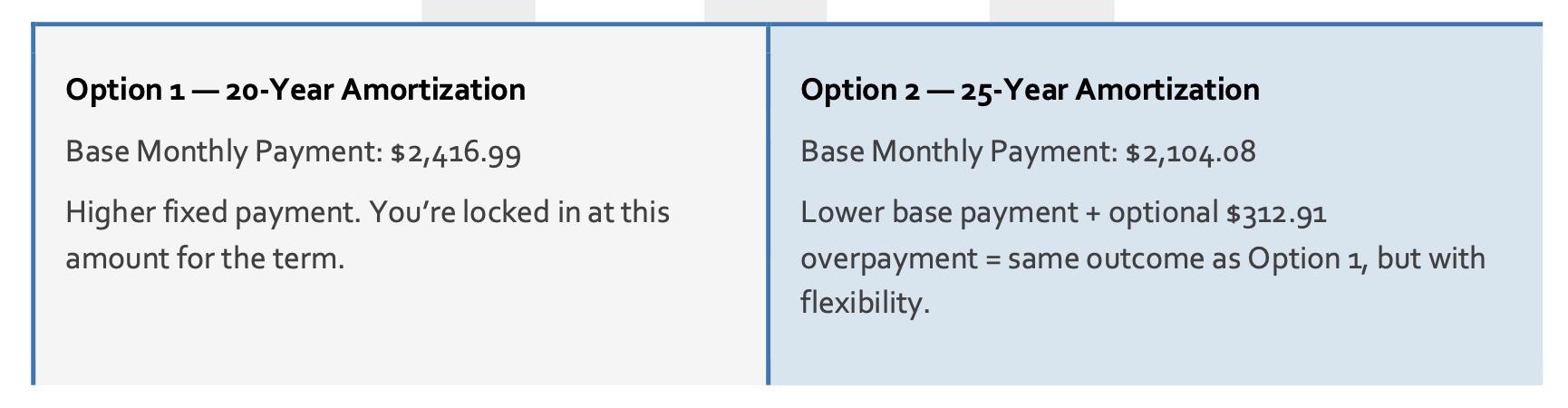
By using your prepayment privileges to voluntarily “overpay” the mortgage each month by $312.91, you achieve exactly the same result as the 20-year amortization, but you retain the ability to stop those overpayments at any time, with no penalty.
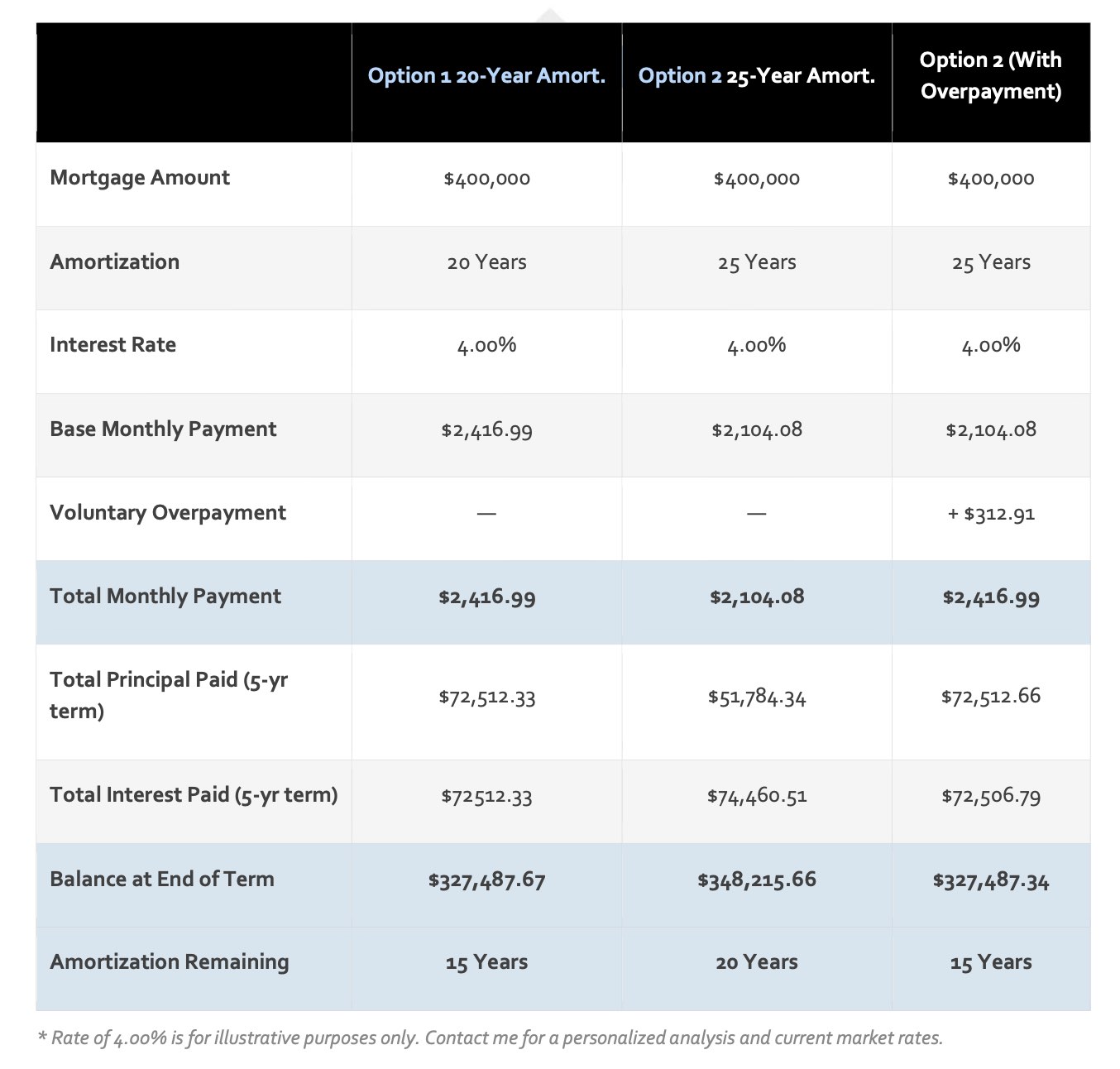
Side-by-Side Comparison (5-Year Term) Option 1 20-Year Amort. Option 2
The Case for Starting With a Higher Amortization
1. You Can Reclaim Cash Flow Whenever You Need It
Life is unpredictable. If your circumstances change, you can simply stop the voluntary overpayments and immediately free up that $312.91/month. Common situations where this matters include:
• A new car payment or unexpected large expense
• Children starting college or university
• A change in employment or household income
• Home repairs or renovations
Key Advantage
Because the overpayments are voluntary, there is no penalty to stop them. If you started with a 20-year amortization instead, accessing that cash flow would require breaking your mortgage, which typically involves a significant prepayment penalty.
2. You May Qualify for a Larger Mortgage
Lenders calculate your qualifying payment based on the amortization period. A longer amortization means a lower required monthly payment, which can increase the mortgage amount you’re eligible for. How much more depends on your overall financial picture. I can run this analysis for your specific situation.
When This Strategy May Not Be Right for You
This approach works best for people who are disciplined about making the voluntary overpayments consistently. If you’re concerned you may not make the overpayments on your own, starting with the lower 20-year amortization can be a better fit, as it forces the higher payment to reduce your debt sooner.
What’s Right for You?
Every client’s situation is different. What works well for one person may not be the best fit for another. The most important thing is that you understand your options and have the flexibility to choose.
Let’s Run the Numbers for Your Situation
I can easily prepare a personalized analysis showing exactly what your overpayment amounts would be, based on your specific mortgage. We can explore amortizations ranging from 5 years up to 30 years to find the structure that gives you the best balance of flexibility and financial progress. Typically, you can set up automated overpayments with your lender after your mortgage closes.